Saturday, October 26, 2013

Fotodiox Pro Filter Adapter / F-Stop Loka Bag


Kathryn Lake, Sawtooth Mountains - Idaho. 14mm, with circular polarizer.

Fotodiox Pro Filter Adapter / F-Stop Loka Bag  


It’s been a while since I had time to slip in some comments here on this blog, or anywhere for that matter, since last spring. During that period of time, when I was laid up from a ski-injured knee, I managed to eek out a few ripe photography pearls, and an odd article here and there for magazines. However, once the knee was healed, it was back to work as usual, and my entries here died on the vine. So, without further adieu, I would like to briefly talk about the Fotodiox Filter Adapter for the Nikon 14-24mm lens, and the F-Stop Loki camera pack.

When I changed over to the Nikon D800, paired with the Nikon 14-24mm lens, I was terrified by the dome of crystal that bulged from the front of the barrel. Thankfully, I have learned to love this lens, and find myself less anxious about the optics - having learned some basic protection skills, and discovering the real value of the Fotodiox adapter.


For $249 I have seamlessly integrated the occasional need for a circular polarizer and the often-needed lens protection factor. The build quality, materials, and optical clarity of this simple kit took me quite by surprise. The f/2.8 14-24 ED lens has a magnificent field of view, and I was nervous about vignetting – no problem. It is such a heavy lens that the added weight of the adapter doesn’t really make a noticeable difference.

Vignetting was my primary concern as the corners of the 14-24mm are very sharp. I didn’t want to loose my full frame view due to soft, and perhaps dark, corners – which would require a post process crop. To my delight, there is no vignetting with this filter adaptor – even with the filter in place. I sometimes correct the lens distortion in Lightroom, but even if I don’t there is no appreciable vignetting.

I was mostly concerned about using the polarizer during mid-day, with lots of sky. Images captured in shade, containing moving water, are a simple thing – adjust the tripod, twist the polarizer to see ‘into’ the water, and click! But broad daylight with sky – that is usually a recipe for disaster. Typically, a polarizer will only darken a narrow portion of the sky, leaving the final image with an unnatural dark blue wedge in the sky. Additionally, you may not even see this in the LCD screen, on site – but may only discover this bizarre sky tragedy when you are at home, all cozy, and viewing RAW images on the 30” Apple monitor.

Somehow, while I was shooting in the springtime desert world of Canyonlands in Utah, I did not get this ‘death wedge’ of dark blue sky. In fact, I got tonally pleasing enhanced skies at even 14mm! I am unsure of the why’s or how’s, all I know is that I used the polarizer at 1pm (the death zone) and got images that were more than acceptable, in fact, they were quite good.

The Dollhouse - Canyonlands, at 14mm.
The polarizer produced no problems with the sky.
 The filter adapter was mounted onto my camera for about 50% of the 7-day expedition. Only a fraction of the time was the circular polarizer in place. The gigantic 145mm lens cap was in place 100% of the time while it was mounted. Not only does the adapter give you a little more flare reduction, it also gives you some cushion while climbing through slot canyons and dodging the occasional willow snap-back. The lens cap is robust, and never came off without my work to remove it. Even if, somehow, an errant branch were to dislodge it, there is no way on earth you would not know it had hit the ground – think of dropping a Frisbee made out of Melmac – the dinnerware of the 50’s (polyoxybenzylmethylenglycolanhydride).

Fotodiox also sells split neutral density filters for this adapter kit, but I have become very comfortable with image exposure blending in Photoshop and have found no need for these extra on-site optical tools.

Fotodiox has produced an amazingly engineered lens hood/adapter/circular polarizer for the boutique Nikon 14-24 lens. If NASA was creating delicately milled aluminum components for the optics of a Jupiter probe, I like to think that this is what it would look like.


F Stop Loka. Petrified tree roots, The Maze, Canyonlands Utah.
  
The F Stop Loka camera bag was another joyous discovery through Trey Ratcliff’s website, “Stuck in Customs”. At 37 liters (2250 cubic inches), this pack is perfect for an entire day on location with all of my gear. And by gear I mean: Nikon D800, 14-24mm lens, 24-70mm lens, 70-200mm lens (the holy trinity), shutter release, Fotodiox Filter and polarizer, batteries, memory, cleaning cloths, business cards, etc. and – water bottle (or bladder), food, rain jacket, ski hat, gloves, fuzzy jacket, personal locator beacon (PLB), sunglasses, minimal climbing gear (mostly for anchoring camera bag to a wall), and my carbon fiber tripod. This backpack, including the Internal Camera Unit (ICU), weighs about 3.5 pounds.

Screen Shot from www.fstopgear.com

The ICU is one of the most unique features of this professional level camera pack. When you purchase the pack, you also have to choose the internal container for the camera gear. Without the ICU, you would just have a large empty daypack – not a bad thing, but that is not why you dropped $330. The ICU’s come in different sizes and shapes, and hold varying amounts of camera equipment.  The “Pro Large” was my choice of ICU. These padded ‘cubes’ of nylon dividers and Velcro straps stuff into the backpack and lock into place with Velcro tabs. Now, here is the best part – to access the contents, you zip open the part of the backpack that lies against your back. Different, huh? Usually you throw your pack into the snow or dirt with the shoulder straps facing down, which gets them all wet or nasty. Not so with the F-stop. The engineers there have put a lot of thought into the design, and decided to have you place the waterproof back panel of the pack into the snow and dirt – not the shoulder straps, brilliant!

The size of the Loka does not allow for overnight hikes, but F Stop makes a much larger version, the Satori, which is a 62 liter pack and quite capable of lightweight overnight exploits. For multi-day adventures I still use my tried and true set-up – years in the making, which will be the discussion for a later blog.

It is a little difficult to explain how this pack works, so I will suggest going to the website and watching a few of their videos. I can honestly say that this is the best camera bag I have ever owned – weddings, model shoots, street shooting, skiing, mountain and desert canyon day trips – it just works so well. Super rugged, well designed and manufactured, this pack has totally replaced almost all of my old Lowepro bags (which I thought would never happen).
Whispering Stones, Kona Coast - Hawaii.

Thursday, February 21, 2013

Photography Workshop 05/18/2013


If you would like to reserve your spot in this workshop, please email me and I will forward a PayPal invoice.
There will only be 8 positions, so once I have them filled, I will close the class. I will also send a PDF version of the above information, answer your questions, and keep track of you via email.


Thursday, January 31, 2013

Symphony of Life


It’s difficult to explain what happened to my wife, Jill. She has been in the water all of her life; swim team, lifeguard, boating, snorkeling, and eventually scuba diving -but it wasn’t until a particularly sunny day, in the dense blue waters of the Andaman Sea, that it happened.

We were eager novice divers on out first “live aboard” trip to the Similan Islands, a hundred miles off the west coast of Thailand. As a photographer, most all of my diving stress is centered on taking my camera equipment under the water. As my dive buddy, Jill’s stress is mostly – me. She keeps a watchful eye on me while we dive – in case I get too close to a lionfish, don’t realize I’m being followed by a barracuda, or stray away from the group, preoccupied by the scenes through my lens. That was our deal. We both watched our gauges (although she was much more vigilant than I) and were generally “easy” clients for the guides. We dove enough to be comfortable at depth and in strong currents. So with this comfort, I focused on my camera and Jill focused on me - until one brilliant afternoon near the craggy black island wall of Koh Bon.


We back-rolled into the water from the tiny blue and red dingy, making it tip crazily as it was unburdened. Amanda, our guide, gave us a quick check and we all descended. As we sank lower, toward a brilliantly colored slanting floor at about 80 feet, I focused on a huge Gregorian fan, trying to frame it for a picture. Jill and I each carry small metal containers filled with ball bearings, that when shaken underwater, send rattlesnake sharp sound waves for great distances. It was our way of saying, “Hey, look at me, I need to show you something!” I took a picture - and then heard Jill’s rattle, prolonged and distressed.

The giant manta drifted above our heads, silhouetted black, wings out wide, gliding into the current in about 40 feet of water.  I tried to get as many pictures as I could as the enormous winged creature soared around us, gracefully turning in large banking arcs. I was stunned by its size and potential for speed, “Its so strong” I thought.


Jill, floating with her arms folded, enveloped by the blue, was suddenly seized by the entirety of the ocean.

She told me that at that very moment, it all came together for her; the entire undersea world of life became tangible and real. A minute before, she had just been diving, but now she was part of it – an infinitely small, meaningless part of it all. It was a symphony of life, from the great manta to the clown fish guarding its anemone; schools of batfish and jacks moving in unison to unseen forces, parrotfish munching rock, gobies watching out for their blind shrimp room mates, cleaning stations filled with millions of fish and crustaceans, damsels darting through staghorn coral, thousands of swirling glass fish - like a dancing veil of fairy dust. Every crack in the reef had an inhabitant. Every hollow in a sponge, or secret passage in a coral contained life. It was an immeasurable puzzle, with all of the pieces in perfect order – and yet in constant motion. The candy-colored world seethed around her in perfect harmony – it was loud, and confusing, and busy – but peaceful and magnificent at the same time. She told me that it was hard to fight back tears, tears that would have obscured the world to her new eyes. All of the cares that she had had just moments before - thoughts of being warm enough, of breathing slow and deep, of wondering always what was behind her, of being too far from me – all were replaced by just the weight of warm water, like she had been taken into the arms of the ocean.

There is no place on earth with a higher concentration of life, or more color per given space. The ocean is life. It is life for this entire world – and yet, we see none of it. The luxury that is afforded to some, the indulgence of diving down into the ocean and witnessing first hand all of its power and life, is something I wish everyone could experience. For Jill it was life-altering; a sudden realization that we on land know nothing of the vast majority of the planet that we call home, and that such life goes on, in such numbers – day and night, shallow and deep, without end. 


Even though we had numerous dives in the Similans prior to this one, for some reason it was the ghostly manta that painted the last brush stroke for Jill. Perhaps the size of something so imposing and gentle, swimming so close to a huddled group of technology-laden air-breathers, put everything else into perspective. The manta, a virtuoso of grace, carved turns around us, coming close, looking at each of use with its great dark eyes. Jill said she looked right into his eye, for as long as he would look back, barely breathing, understanding. She never wanted to go back up.

Once out of the water Jill exclaimed, through tears, “I can not believe that entire performance down there, it goes on 24/7! Its like a Vegas show that never ends!” It was something that she could not shake from her head for days - and even now, with a single inquiry, it returns to her instantly with all of its vivid magic – the greatest show on earth. That such a place exists, that has always existed - is truly hard to believe unless seen.


After that day we did many more dives in the Similans, and often times with the mantas. These amazing fish are the size of garage doors and agile like hawks. We were so enchanted by their presence that a year later we made a trip to the Komodo Islands just for mantas. Again, we were with our guides from Thailand, and again they knew where to find the winged ghosts, and again we dove with them – but this time it was different.

In a strong current in about 60 feet of water, hugging the gravel floor of the ocean channel, twelve manta rays drifted around us like shadowy kites. I watched as Jill, arms out wide, slowly waved her arms up and down, as if she was a manta, beckoning them closer so that she could look into their eyes once again. Elegantly and slowly, a large black manta worked its way toward Jill; its great gilled mouth open wide, taking in plankton from the swift moving water. I switched the camera to video and watched as the massive animal just hovered next to her, its wingtips moving just enough to keep it from being carried away in the current. They were close together for several minutes – each looking at the other in fascination. The others soared around like a flock of pterodactyls in slow motion, looping and banking and diving – always to angle themselves into the current for another mouthful of plankton. When we had run dangerously close to our air limits, we reluctantly grouped up tight and slowly ascended to the surface, always looking down until the mantas vanished in the food-rich waters. We dove this exact spot three more times, each dive becoming longer and longer as we learned to conserve air, and each time dreading the need to return to the surface.


In an overwhelming interaction with the grand manta ray, Jill found within her a sense of scale and wonder and emotion that she had never had before. It’s why we will go back to the waters of the coral triangle, and it’s why we read and study and support all of the conservation work being done by a variety of energized groups.  The devilfish, as the giant manta was once known, is shortlisted for an endangered species classification, and without intervention, the species will disappear into the depths of history. To see something this majestic in the open ocean is hard to describe; it’s a marvel of design for sure - and so much more. 


www.hartimages.com
__________________

If you would like to know more about manta rays, to donate to their conservation and research, or to even adopt one – please click on the links below. The hour-long movie is also well worth the watch.


Monday, January 28, 2013

Mountain Men


For anyone who has ever traveled to rural Nepal, specifically the mountains of the Khumbu Valley, there is little to say about the local Khumbu people except – remarkable. The harsh environment and isolated folds of earth have created an idyllic kingdom of sturdy, devout Buddhists - and tough shaggy animals.

The Sherpa people are the indigenous inhabitants of the Solu Khumbu valley and are descendants of nomadic Tibetans from the north.  For 600 years they have lived in this high-altitude realm, becoming stronger and leaner than their first-world Cheeto-fed vacationer/employers. They are a happy, patient people, filled with the potential for sudden impromptu comedy. They have very little western wealth or possessions; no 403’s, health insurance, workman’s comp, welfare, life insurance, second cars (or even first cars), or storage units filled with boating gear and Christmas paraphernalia. They wear flip-flops over any terrain, sport one-dollar gas station quality sunglasses, wear cast-off Hawaiian shirts donated from more fortunate countries, smoke hand-rolled cigarettes, carry more than their bodyweight of luggage, wood, rock, or alcohol each day -and do it all in the rarified air of the Himalayas.

I am never so humbled as when I return to the mountains of Nepal. On arrival to Lukla, a postage-stamp of an airport licked and pasted to the side of a 21,000-foot peak, you are instantly aware of who is fit – and who is not. You walk slowly and gulp in the thin air, while barefooted children run past carrying your gear - and laugh.  You try to convince yourself that in a week’s time you will be acclimatized to the elevation. Do not deceive yourself – the people of this valley will always be able to kick your ass.

Technically, the Sherpa people tend to be guides or lodge owners, and the porters are often times from the lowlands (a consideration when hiring men to haul your gear, as the lowland porters are not accustomed to the elevations like the local Khumbu people). If you are trekking in the Everest region, and are a responsible client, then you are following the rules of the IPPG (International Porter Protection Group) who have outlined load limits for porters in Nepal, Pakistan, Peru, and Kilimanjaro. The Nepali porter load is to be limited to 30kg, and their wages should be between 500-700 rupees a day (USD 6-8/day, actually about half of what they should be paid). Receiving such low wages for staggeringly hard work is only half of the porter equation. Each night, as you snuggle inside your $700 down bag within the stone and wood confines of a sturdy teahouse, your porters are outside – perhaps in a tent, in a local friends kitchen, or a mile or two away in a family members house.

Through foreign donations and planning, there are now an increasing number of porter shelters that have been built to protect the lowest paid members of your trekking party from the harsh nighttime elements. There are recognized porter shelters at Tengboche, Gorak Shep, Gokyo, and Machermo. These rudimentary structures are free bunkhouses for the porters and Sherpas, getting them out of the wind and cold, and saving them from hiking extra miles. Also, Porters Progress UK has a donation store in Lukla that helps outfit underdressed porters with donated boots, jackets, and sunglasses from western trekkers.  As a trekker, you are responsible for your porters.  If a porter falls ill, it is the responsibility of you and your group to ensure he is not just paid off and sent away, but that he is accompanied to a clinic.

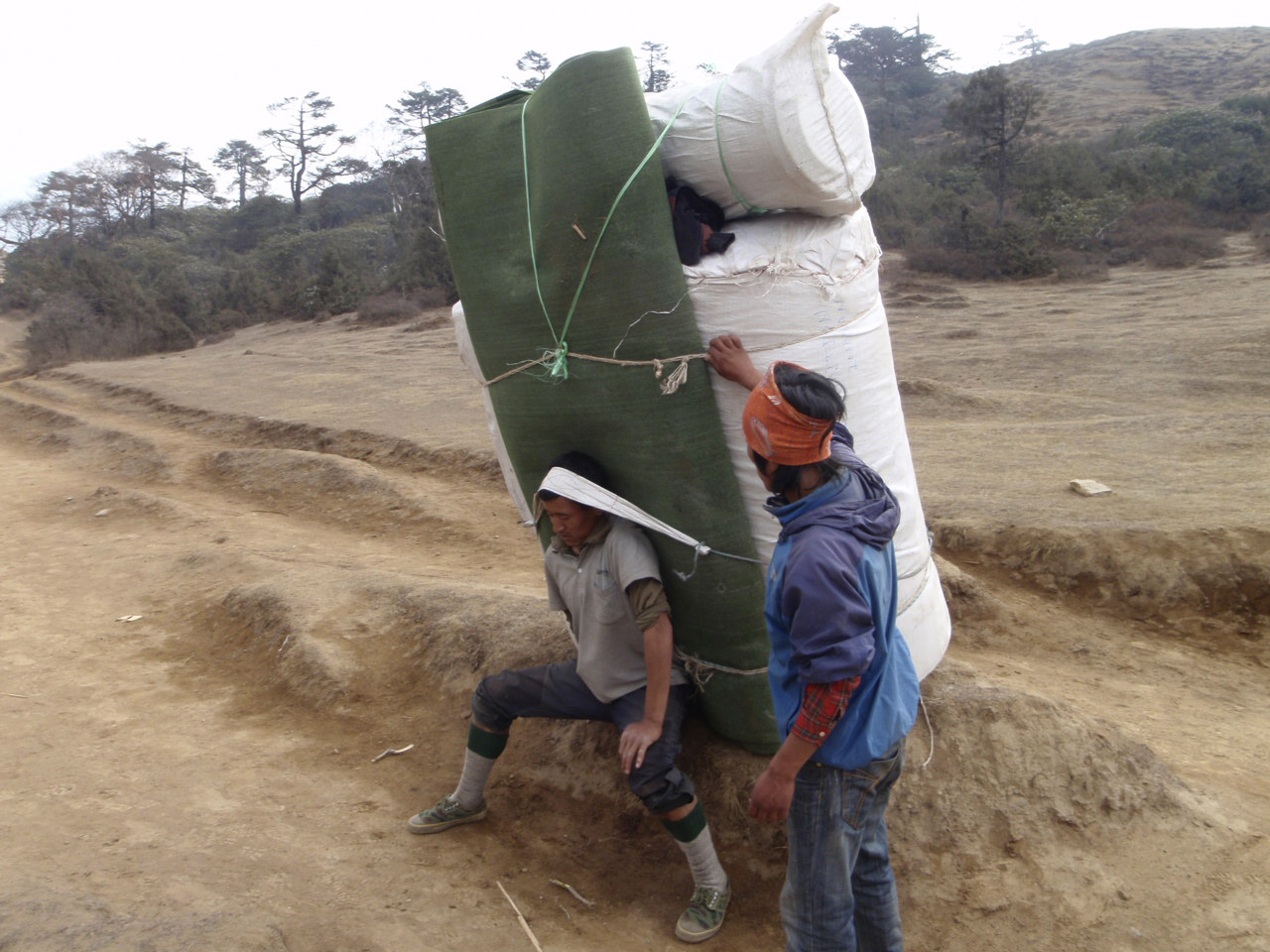
I have seen porters carrying hundreds of pounds, suspended from their heads by crude fabric “tumplines”: gigantic green-cut wooden beams, sixteen foot lengths of corrugated tin roofing, eight cases of bottled beer, a small refrigerator, 150 gallon water tanks, great slabs of granite – almost everything you see in the villages of the Khumbu were carried on the backs of men. Most of these extremes are not linked to trekking, but are feats of strength in the simple delivery of goods – human UPS trucks in jelly sandals. If you need it, and are willing to pay to get it there, then there is a guy somewhere willing to carry it – that’s exactly how the slate-topped pool table got to Namche, and the huge panes of glass to Pheriche.

In 2005 a team of Belgian physiologists performed field-testing related to the energetics of hauling loads with tumplines. They studied porters who routinely hiked 100km - from the Kathmandu valley to the village of Lukla – delivering goods. They executed this journey in about 9 days, gaining around 26,000 feet in elevation and loosing 22,000 feet during the round trip. They were aged from 11 to 68 years of age with the men hauling an average 93% of their body weight. One particularly robust porter was measured carrying 183% of his body weight! Their study concluded that the Nepali porters were, "far more economical, energetically, than the controls at all loads, and more economical than African women at all except the lightest loads."1 Perhaps we have this backpack thing all wrong.

In the spring of 2012 a Sherpa lodge owner fell off of his tin roof while shoveling snow in Pheriche, sustaining a fracture / dislocation of his elbow. This was too complex for the physician at the Pheriche aid post, so it was decided that he should go to Kathmandu for a higher level of care. On the evening before, a wealthy solo female trekker, who had been led up the valley on the back of a pony, suddenly decided she had seen enough and was “done”. With VISA card in hand, she ordered the Pheriche clinic to arrange a helicopter transfer back to Kathmandu. This was fortunate for the Sherpa, as most often their only form of evacuation was by porter, pony, and truck, and took several days. In this case, the physician arranged to have him fly back with the wealthy trekker. Good karma was at hand.

I watched as the helicopter danced around the ring of stones like a dragonfly adjusting to a flower. Just as it touched down, local men wearing puffy jackets waded through the snow and began taking out jugs of kerosene and boxes of supplies (no helicopter flight in the Khumbu goes up or down the valley without a payload).   Then I saw the woman’s wheeled luggage carried out to the waiting craft, blades whirling and engine roaring, followed by two Sherpa assistants with the “fancy lady” as one porter called her. They held her hands to guide her balance as she carefully tiptoed through the snowy rocks to her taxi. People gathered, both locals and trekkers alike, as the medical clinic staff brought the injured Sherpa out of the medical building on a stretcher. There was conversation inside the helicopter between the woman and the pilot. The doors were closed. The engines roared louder – and the helicopter rose up into the air in a swirling cloud of sparkling ice crystals.  The physician and the litter attendants rushed the injured man out onto the landing zone, waving and yelling into the glittering vortex – and watched in vain as the small craft swiftly vanished down the valley and out of sight.

They carried the man back into the clinic. Such was the fate of just a Sherpa.

I like to think that karma found that woman; found the deep recesses of her intestines while she was sitting in the Kathmandu airport waiting for her international flight; found her thriving with a demonic spawn of bacteria that would give rise to torrential diarrhea, making her flight the most memorable of all time.

The Sherpas and porters of the Khumbu valley risk everything they have to make a living - to send their children to school, to afford food and clean water. They carry their bodyweight in tourists’ luggage, cut river stones into bricks with a hammer and chisel, create wooden beams with hand planes and sweat, and run down treacherous trails for ten miles to relay a message for a trekker. Their unprotected eyes become milky and dim after years of crossing snowfields, they climb to great dangerous heights, carry cylinders of oxygen through crevasses - and give up their chairs to foreigners. And if asked why, each one of them will tell you the same thing – so my children won’t have to.

When in Nepal, treat these hardy people with the respect deserved of such effort. Ensure they are paid fairly, that they will receive medical treatment, and that their loads are not too great. Donate to funds that create porter shelters, or to teachers at the schools of Lukla and Khumjung. Leave your old trekking poles, boots and sunglasses in Lukla. Join the Himalayan Rescue Association and donate to Stop Girl Trafficking. Limit the number of plastic bottles you buy and showers you take. Give the right-of-way to any porter. Engage them whenever you can.

We are just fortunate transients in their mountains. It is our duty to be worthy ambassadors for our respective countries, to promote kindness and fairness, and pay forward even the smallest acts from the heart.


~ our porters in 2012 

__________________________
1 Bastiene, G.J., B. Schepens, P.A. Willems, N.C. Heglund (2005). Energetics of load carrying in Nepalese porters. Science, 308:1755.